Subterranean termite treatment addresses the specific structural risks presented by Alabama's dense populations of native subterranean termites (*Reticulitermes*). In Jefferson County, the high iron content and…
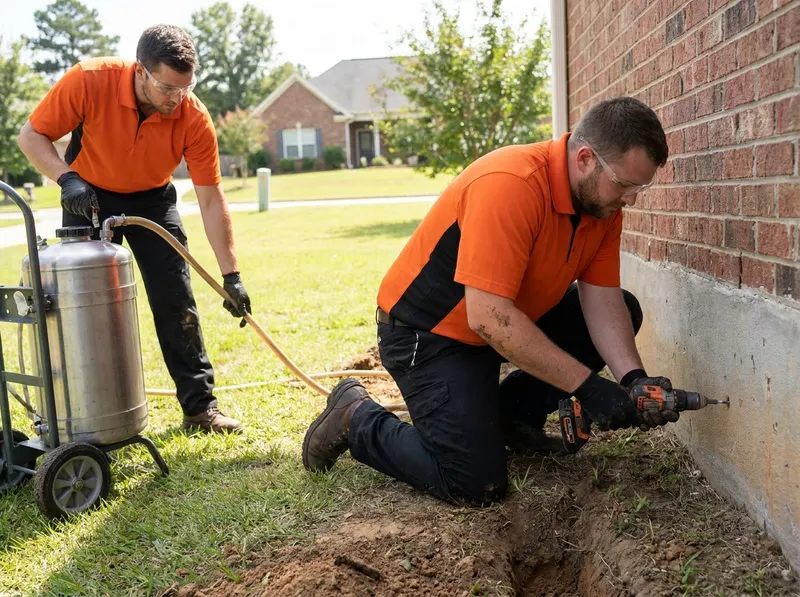
Subterranean termite treatment addresses the specific structural risks presented by Alabama's dense populations of native subterranean termites (*Reticulitermes*). In Jefferson County, the high iron content and moisture retention of red clay soil provide ideal sub-surface nesting conditions, allowing colonies containing hundreds of thousands of workers to tunnel into foundation sills undetected. Homes situated near heavy tree canopies and historic grades, such as older crawlspace bungalows in Glen Iris, Forest Park, and Highland Park, frequently experience wood-to-ground contact that invites colonization. Rather than applying broad interior sprays, technical management relies on an exterior perimeter barrier that treats the exact points where soil meets brick, stone, or poured concrete.
Technicians establish this defensive barrier by trenching four to six inches into the soil alongside foundation perimeters and injecting non-repellent termiticides such as fipronil at a regulated depth of up to four feet. For homes with attached concrete patios, carports, or garages commonly seen across Crestwood North, Avondale, and Crestline Park, sub-slab injection via precision-drilled half-inch access ports delivers the active barrier beneath the masonry. Worker termites move freely through the non-repellent compound, carrying the material back into subterranean galleries through grooming behavior, which systematically collapses the colony. Monitored baiting systems placed every 10 to 15 linear feet offer an alternative or complementary measure for properties with sensitive landscape beds or drainage limitations near East Lake and Roebuck Springs.
Selecting between comprehensive liquid trenching and baiting matrices depends on structural architecture and soil grading. Liquid soil treatments provide an unbroken chemical zone designed to remain effective for five to eight years, though steep hillside grades or dense root systems near foundations can require supplementary rodding. Bait stations eliminate the necessity of concrete drilling around historic masonry in neighborhoods like Five Points South and Smithfield, yet they require recurring monitoring intervals to replenish cellulose bait matrices. The operational process follows a clear structure: 1. A physical perimeter assessment identifies shelter tubes, moisture collection zones, and linear footage. 2. Technicians dig narrow soil trenches along the foundation base. 3. The non-repellent barrier is delivered into the soil. 4. Displaced clay is backfilled and treated to seal the subterranean perimeter. Exact costs reflect perimeter footage and crawlspace clearance, confirmed on-site prior to application.
Every job gets a firm, written price after a free on-site visit.
Tell us about your subterranean termite treatment job in Birmingham and we'll send a clear, written quote, usually the same day.
 Kelvoro Pest Barrier